Best American Museums - Top 10 Must-Visit Museums in the US
Seeking the best museums in America? Discover the top 10 must-visit museums in the US, from art to history to science, with info on exhibits and why you can't miss them.
 Ella Eleanor

The 10 Best American Museums You Must Visit
America is a country filled with iconic museums that illuminate human history, art, science, and culture. From Washington D.C.'s famed Smithsonian Institution to modern art meccas like LACMA in Los Angeles, museums have long served as gateways to knowledge and discovery for both Americans and international visitors alike.
This article highlights the 10 best American museums based on their world-renowned collections, innovative exhibits, stunning architecture, historical significance, and popularity amongst visitors. The museums on this list range from massive complexes with multiple venues to standalone institutions dedicated to specific subjects. But they all have one thing in common - they showcase the pinnacle of human achievement throughout the ages.
Whether you’re an art aficionado looking to view rare masterpieces, or a science buff eager to see famous spacecraft and artifacts, these 10 museums offer one-of-a-kind experiences you won’t find anywhere else. So get ready to immerse yourself in human history and culture. Here are the 10 best American museums you simply must visit in your lifetime.
Background on Museums in America
Museums have played a vital role in American life for over two centuries. The first major public museums opened in the mid-1700s, offering visitors a glimpse into natural history through collections of scientific specimens and artifacts. In the late 1800s, wealthy businessmen like J.P. Morgan, Henry Clay Frick and Andrew Carnegie established some of the most influential art museums in the country, including the Metropolitan Museum of Art, the Frick Collection, and the Carnegie Museums.
Over time, the museum landscape diversified dramatically to reflect the breadth of human knowledge and experience. Today you’ll find museums devoted to topics as broad as African-American history and culture, aviation, anthropology, agriculture, espionage, folk art, mining, medicine, rock n’ roll music, and more. The diversity and accessibility of modern museums contributes immensely to public education and engagement.
In terms of sheer size and number of artifacts, it’s hard to surpass the Smithsonian Institution’s 20+ museums clustered primarily on the National Mall in Washington D.C. But every region of America now boasts impressive museums that combine comprehensive collections with top-notch facilities and interactive experiences. The criteria used to rank the best American museums included collection size, reputation, uniqueness, attendance numbers, exhibits, architecture, awards, and expert recommendations.
The top museums highlighted below are considered destinations for their ability to inform, inspire, and ignite curiosity about the world we live in - past, present, and future.
10 - The Getty Center (Los Angeles, CA)

Perched high on a hilltop overlooking Los Angeles, The Getty Center presents visitors with breathtaking views along with an exceptional collection of Western art. The Museum’s extensive photographic archive and rotating exhibits focused on sculpture, drawings, manuscripts, and paintings offer a comprehensive survey of art from medieval times through the 20th century.
Renowned architect Richard Meier designed the Getty Center’s six buildings in a modernist style, seamlessly integrating galleries, gardens, and outdoor spaces. Visitors can wander through 134,000 sq. ft of exhibition space spread out over two floors, enjoying European masterpieces by Monet, Rembrandt, and Van Gogh. The Museum also offers panoramic views of the city skyline and ocean.
The J. Paul Getty Trust was established by oilman J. Paul Getty in 1953 to promote art appreciation. After Getty’s death in 1976, the Getty Center opened in 1997 as the primary location of the eponymous Trust. With free admission and parking, The Getty Center remains a premier destination for art lovers visiting Southern California. The diverse paintings, drawings, sculptures, manuscripts, and photographs provide a comprehensive overview of art history.
9 - National WWII Museum (New Orleans, LA)

The National WWII Museum in downtown New Orleans is America’s leading institution focused on the World War II era. The Museum presents immersive exhibits with artifacts, oral histories, photographs, and interactive components that transport visitors back in time to the war years of the 1940s.
Popular permanent exhibits include the Road to Berlin, examining the European theater, and the Road to Tokyo, focusing on the Pacific. The Museum’s vast collection of over 100,000 artifacts range from personal letters and keepsakes to tanks, aircraft, and even a submarine. The on-site Restoration Pavilion and US Freedom Pavilion provide front-row seats to watch preservation work in action.
Since its origins as the D-Day Museum in 2000, the institution has expanded to encompass a six-acre campus. Multiple constructed pavilions house themed exhibits, while the Louisiana Memorial Pavilion showcases short films about the war. The Museum aims to honor the contributions of the Greatest Generation while educating new generations about the war’s profound impact. Attendance routinely tops 800,000 annually, affirming this Museum’s reputation as the top destination for exploring America’s WWII history.
8 - The Broad (Los Angeles, CA)
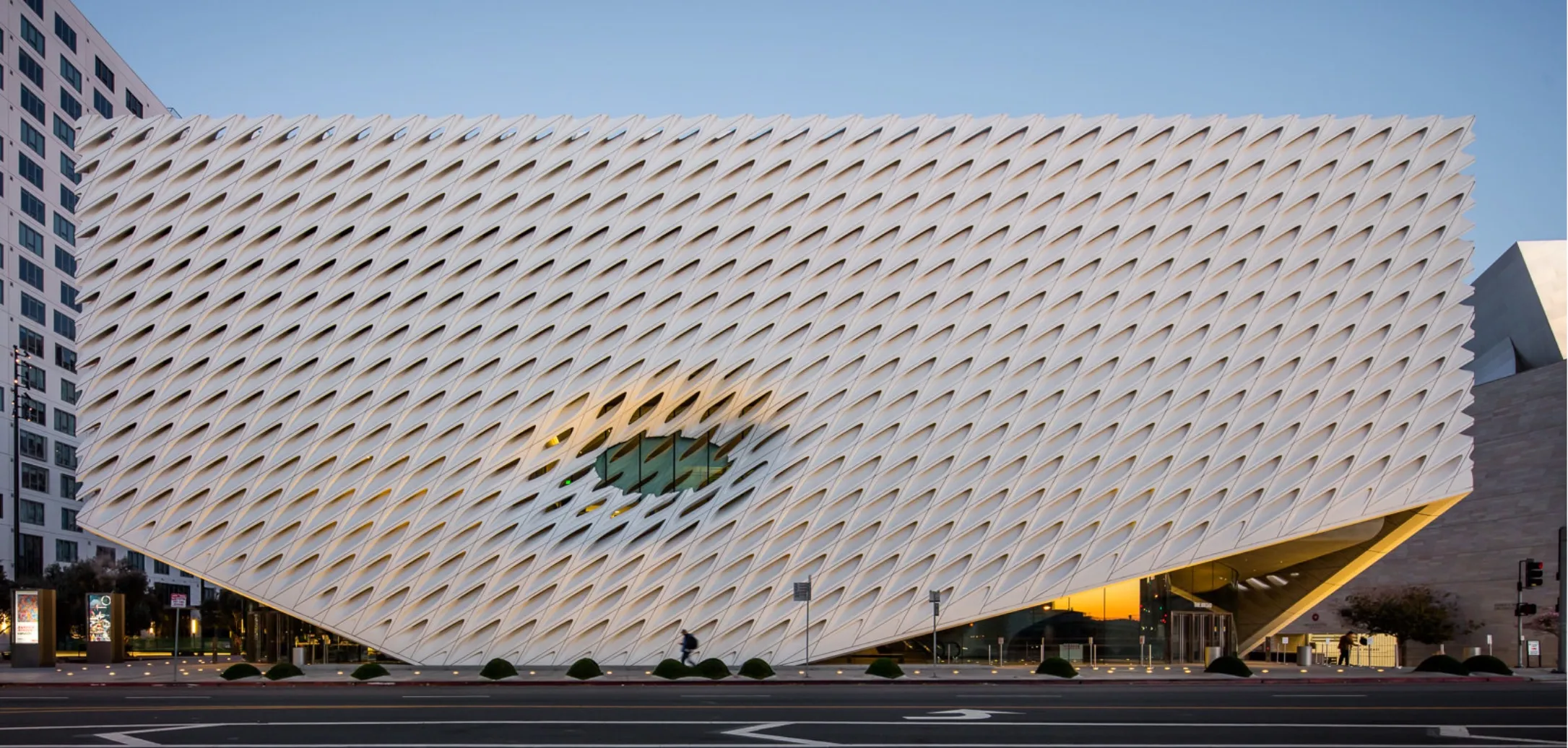
Billionaire philanthropists Eli and Edythe Broad opened this contemporary art museum in 2015 to house their expansive personal collection. The Broad’s striking architectural design resembling a honeycomb or bustling hive welcomes visitors into its light-filled galleries.
The permanent collection boasts around 2,000 works by prominent artists like Andy Warhol, Roy Lichtenstein, Cindy Sherman, Jeff Koons, Barbara Kruger, and more. One of the most popular pieces is Yayoi Kusama’s Infinity Mirrored Room, an immersive mirror installation. The Broad also features rotating temporary exhibits and offers an extensive lineup of public programs.
Located in downtown Los Angeles, The Broad makes contemporary art accessible to the public free of charge. The museum’s collection captures significant art movements from the 1950s to the present. Visitors can immerse themselves in iconic pop art, minimalism, conceptualism and other experimental genres that shape today’s artistic landscape. Eli and Edythe Broad originally lent their collection to art institutions, but ultimately opted to open their own modern and contemporary art museum. The Broad is now an essential destination for experiencing leading contemporary artworks.
7 - The Henry Ford (Dearborn, MI)

Dedicated to innovation and ingenuity, The Henry Ford encompasses multiple attractions all focused around American history. The anchor site is the Henry Ford Museum of American Innovation, which contains a sweeping array of exhibits highlighting American pioneers and trailblazers. Visitors can see Thomas Edison’s laboratory, the bus where Rosa Parks took her stand, Buckminster Fuller’s Dymaxion House, the Lincoln Rocker, and other iconic artifacts.
Complementing the Museum are the interactive Henry Ford Science Center, the auto-themed Steel Home, Ford Rouge Factory Tour, Benson Ford Research Center, IMAX theater, and Henry Ford Academy school. Together these immersive attractions celebrate the spirit of innovation and the visionaries who shaped American culture through their inventions, ideas, and dedication to progress. Located just outside Detroit, The Henry Ford is a national treasure and a must-see for anyone interested in the history of science, technology, and industry.
6 - National Air and Space Museum (Washington, D.C.)

As part of the Smithsonian Institution, the National Air and Space Museum is the most visited museum in the United States and with good reason. The main Museum location on the National Mall in Washington D.C. houses the largest collection of historic aircraft and spacecraft in the world.
Iconic exhibits include the Spirit of St. Louis plane flown by Charles Lindbergh, Chuck Yeager’s sound-barrier-breaking Bell X-1, and the Apollo 11 command module. Visitors can also touch a real lunar rock, see astronauts’ space suits, and marvel at aircraft ranging from the Wright Brothers’ Flyer to the Boeing 747. IMAX movies and flight simulators add an immersive element.
The Steven F. Udvar-Hazy Center in Virginia serves as an annex to provide additional hangar space for thousands of aviation and space artifacts that don’t fit at the main Museum. Together, these two locations pay tribute to the human quest for flight, space travel, and aeronautics innovations that have propelled us into the skies and beyond. The scale and significance of the collection cements the Air and Space Museum as one of America’s treasures.
5 - Metropolitan Museum of Art (New York City, NY)

Few art museums in the world can match the encyclopedic collection housed at New York City’s Metropolitan Museum of Art, or the Met. With over 2 million works spanning 5,000 years from every corner of the globe, the Met offers an unparalleled art experience.
The expansive permanent collection is organized into curatorial departments including Egyptian Art, American Decorative Arts, Arms and Armor, Modern and Contemporary Art, Costume Institute, Musical Instruments, Photographs, and more. Highlights include stunning Temple of Dendur, glassworks by Tiffany and Gallé, American period rooms, provocative contemporary works, and galleries packed with masterpieces from Renaissance, Impressionist, and Pop artists.
Since its founding in 1870, the Met has evolved into a thrilling cultural attraction. The Museum sees over 7 million visitors annually, making it a perennial favorite and a world-class destination for art lovers. As one of the largest and most comprehensive art museums in the world, the Met is a not-to-be-missed treasure.
4 - Field Museum of Natural History (Chicago, IL)

The Field Museum is a Chicago icon and one of the largest natural history museums in the world. Exhibit halls contain diverse collections of botany, anthropology, geology, zoology, and paleontology. The most famous permanent exhibits include the grand Titanosaur cast, Maximo the T. rex fossil, the Grainger Hall of Gems, and Egyptian artifacts including multiple mummies.
Interactive displays let visitors walk through an ancient Egyptian tomb, investigate DNA science, handle meteorites, and see scientists working in labs. The 165,000 sq. ft Evolving Planet exhibition chronicles 4 billion years of life on Earth. Special exhibits have included tomb treasures from China’s first emperor and the most complete T. rex ever found.
The Field Museum Library contains over 250,000 books, and the institution sponsors global research and educational programming. Located in a gorgeous Beaux-Arts building originally constructed for the 1893 World’s Fair, the Field Museum has been inspiring curiosity for over a century. With 21 million specimens and artifacts, it stands as one of the great natural history museums.
3 - National Museum of African American History (Washington, D.C.)

Opened in 2016, the National Museum of African American History and Culture instantly became one of the nation’s most important and popular museums. The 400,000 sq. ft building contains exhibits spanning slavery, Reconstruction, Harlem Renaissance, civil rights, Black popular culture, and African diaspora.
Powerful permanent exhibits include slave cabins from South Carolina, a Jim Crow-era segregated Pullman train car, Emmett Till’s casket, Harriet Tubman’s hymn book, Parliament Funkadelic’s Mothership, and over 36,000 artifacts illuminating African American stories and achievements. Special exhibits have covered themes like Black fashion, hip hop, and visual arts.
The Museum provides an immersive and emotional experience while advancing dialogue around race, representation, and the African American experience. Located on the National Mall alongside other Smithsonian landmarks, it has welcomed nearly 7 million visitors since opening. The Museum’s scale, collection, and mission cement its status as an essential American cultural institution.
2 - American Museum of Natural History (New York City, NY)

The American Museum of Natural History is a New York icon and one of the most celebrated museums in the world. Its preeminent collections contain over 34 million specimens and artifacts illuminating anthropology, zoology, human history, evolutionary science, astronomy, and the natural world.
The AMNH is renowned for its fossil collections, including towering dinosaur skeletons in the Hall of Saurischian Dinosaurs and iconic dioramas of mammal prehistory in the Hall of North American Mammals. Other highlights include the Millstein Hall of Ocean Life’s giant blue whale model, the Rose Center’s space shows in the Hayden Planetarium, and the ethnographic Hall of Northwest Coast Indians.
Since opening its doors in 1869, the AMNH has pioneered natural history education and research. Exhibitions highlight biodiversity, human cultures, ancient lifeforms, and the vast scale of the observable universe. Located on the Upper West Side of Manhattan, the Museum contains 45 exhibition halls spread out over four city blocks. With an average of 5 million annual visitors, the AMNH stands as one of the most celebrated and informative science museums worldwide.
1 - Smithsonian Institution (Washington, D.C.)

The Smithsonian Institution is a national treasure and the world’s largest museum, education, and research complex. The 19 Smithsonian museums in Washington, D.C. along with the National Zoo contain an astounding 154 million artifacts and specimens.
Popular Smithsonian museums on the National Mall include the National Air and Space Museum, National Museum of Natural History, National Museum of American History, National Museum of African American History, and the National Portrait Gallery. Other sites include the National Postal Museum, Smithsonian American Art Museum, and the Renwick Gallery dedicated to American craft.
Beyond public museum exhibitions, the Smithsonian engages in pioneering scientific field research while offering educational programs and publishing their own series of books and magazines. Established in 1846 with funds from British scientist James Smithson, the organization aims to promote knowledge and community benefit through accessible museum experiences and scholarship. For any visitor exploring the nation’s capital, the sprawling Smithsonian complex offers endless opportunities to learn and be inspired.
The 10 museums highlighted here reflect America’s cultural wealth and diversity. From art temples to institutions saluting innovation, these world-class destinations inform millions of annual visitors while preserving treasured artifacts. Beyond public enjoyment and education, America’s best museums also lead vital research, conservation, and community outreach programs. By discovering the stories and innovations of the past, visitors to these museums better understand their place in the nation’s unfolding journey.
So embark on your own expedition through human history, art, and science. Let curiosity be your guide as you explore some of the finest museums in America and the entire world. An enriching and enlightening experience awaits.
Tips for Visiting America’s Top Museums
To make the most of your museum visits, keep these tips in mind:
-
Purchase tickets in advance online when possible to avoid long lines
-
Allow plenty of time - museums like the Smithsonian can take multiple days to fully explore
-
Wear comfortable shoes and clothing, as you’ll be on your feet most of the time
-
Read about current special exhibits ahead of time to help plan your visit
-
Ask about free public tours or audio guides to enhance your experience
-
Take breaks to recharge - museum fatigue is real even at the best museums!
-
Check museum websites for dining options - many have multiple cafes and restaurants
-
Photography policies vary, so read up on photo rules before snapping pics
-
Join as a member for added benefits like special previews, discounts, and more
Family-Friendly American Museums
Many top U.S. museums go out of their way to cater to younger visitors. Here are some standout family-friendly museums:
-
California Science Center - hands-on exhibits & live demos
-
Museum of Science, Boston - 600+ interactive displays
-
Philadelphia Children’s Museum - inventive hands-on exhibits
-
National Museum of American History - interactive “America on the Move” exhibit
-
The Field Museum, Chicago - kids ages 5+ can go on fossil digs
-
Griffith Observatory, Los Angeles - engaging astronomy exhibits
America’s best museums are crown jewels of culture, history, science, and education. Plan your own journey through these world-class institutions and discover your place in the never-ending human adventure.GlobetrotterGO